 GREEN BOATING BLOG
Super Fast Sailboat — When Wind Alone Breaks Speed Records
There is something almost impossible about watching a sailboat outrun a speedboat. Yet that is exactly what modern kite-powered craft are doing. While the rest of the marine industry chases incremental efficiency gains, a small group of designers and daredevil sailors has taken a radically different path: harvesting the power of wind hundreds of feet above the water, where it blows faster and steadier than any mast-mounted sail could ever reach.
How kite sailing works
A traditional sail is limited by the height of its mast. Even the tallest superyacht rigs top out around a hundred metres, and the wind down at sea level is often turbulent and slow. A kite, by contrast, can be flown at altitudes of 100 to 300 metres — sometimes higher — where the wind is typically 20–40% stronger and far less gusty.
The kite is controlled by a computer-managed winch system that continuously adjusts its angle of attack and figure-eight flight pattern to extract maximum thrust. That pull is transmitted to the boat through high-strength lines, propelling the vessel forward with forces that would rip a conventional rig apart.
The speed record chase
Speed sailing has always attracted fanatics. The outright world speed sailing record has changed hands many times, but the most dramatic recent leaps have come from kite-powered craft and highly specialised hydrofoil designs.
In 2012, Vestas Sailrocket 2 set the outright world speed sailing record at 65.45 knots (121.1 km/h) over a 500-metre course. That record still stands today. Sailrocket 2 was not strictly a kite boat — it used a rigid wing sail — but it proved that wind-powered craft could exceed the speed of the wind itself by a factor of nearly three, a concept that seemed physically impossible to generations of sailors.
More recently, kite surfers on specialised hydrofoil boards have routinely hit 40–50 knots in short bursts, and dedicated kite-powered boats have pushed well into the 50-knot range. The SP80 team, a Swiss-French project, is actively developing a kite-powered hydrofoil specifically designed to break the 80-knot barrier — well beyond the current record.
Why kites beat sails at speed
Three factors give kite propulsion its edge:
- Altitude advantage: Wind speed increases with height. A kite at 200 metres experiences significantly more power than a masthead sail at 30 metres.
- Apparent wind magic: As the boat accelerates, the apparent wind shifts forward. A kite can be dynamically reoriented to keep working at an optimal angle, whereas a fixed sail becomes increasingly inefficient.
- Reduced drag: There is no mast, no standing rigging, no heavy boom. The only thing in the water is the hull — or better yet, a slender hydrofoil — so parasitic drag is minimal.
The green case for kite power
Beyond the thrill of speed, kite propulsion is one of the most promising technologies for reducing emissions in commercial shipping. Several companies, including AirSeas (a spin-off from Airbus) and SkySails, have developed automated kite systems for cargo ships. A 320-square-metre kite can reduce fuel consumption on a merchant vessel by 10–15%, and larger systems promise 30% or more.
For recreational boating, the implications are equally exciting. A small cruiser equipped with a compact kite system could make ocean passages without burning a single litre of diesel. The kite packs down into a bag smaller than a conventional sail wardrobe, and the control system requires no engine-powered winches — just a laptop-sized brain and a set of lines.
What the video shows
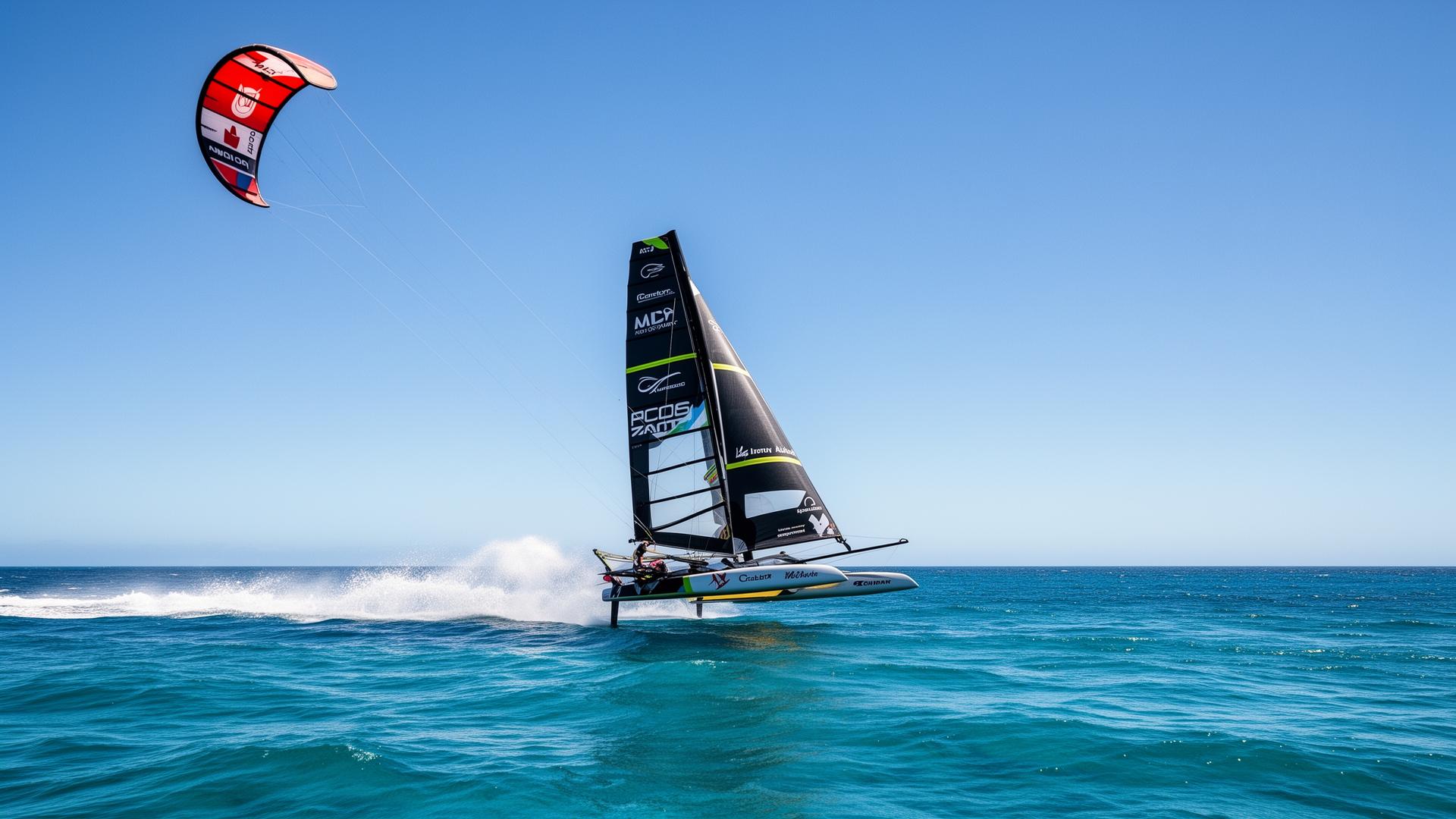
The footage that inspired this post captures a high-tech kite-powered sailboat at full tilt. The kite is a ram-air design — essentially a paraglider on steroids — flying in a tight loop while the boat beneath it skims across the surface on hydrofoils. The speed is visceral. Spray erupts from the foils. The hull barely touches the water.
It is a reminder that the future of green boating does not always look like a quiet electric pontoon puttering across a lake. Sometimes it looks like a missile with a kite on a string, proving that renewable energy can be not just sufficient, but spectacular.
The road ahead
Kite propulsion is not yet practical for every sailor. It requires new skills, new safety protocols, and a tolerance for technology that is still maturing. But the trajectory is clear. As automated control systems improve and kite materials become lighter and stronger, we will see kites on cruising catamarans, expedition yachts, and possibly even commercial ferries.
For now, the speed record chasers are doing the hard work — testing the limits, breaking things, learning. The rest of us get to watch, learn, and eventually benefit from a technology that turns the sky itself into a fuel tank.
Watch: This High Tech Kite Powered Sailboat Just Broke a Speed Record