 GREEN BOATING BLOG
Electric pod motors for boats: a complete overview of what you can buy today
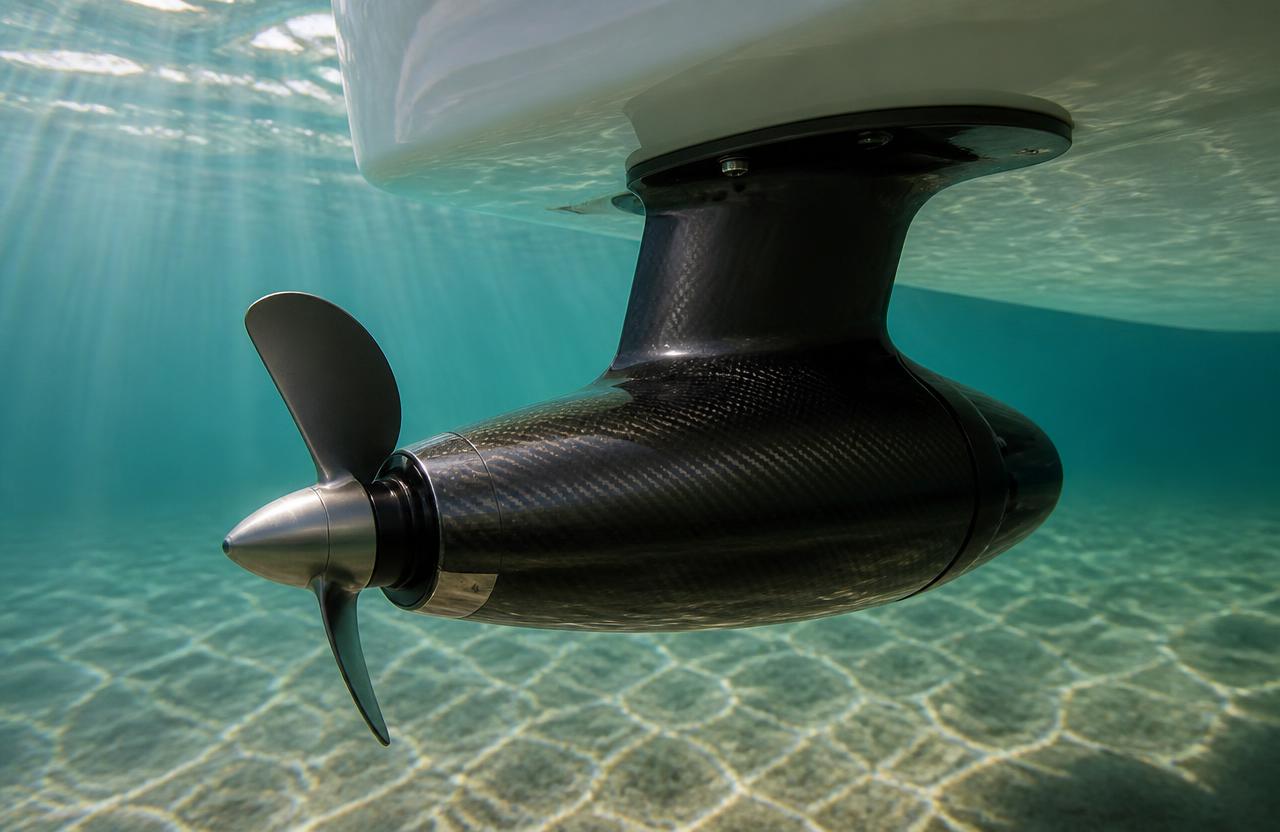
If you are thinking about repowering your boat with electric propulsion, sooner or later you will run into the word pod. A pod drive is simply an underwater housing — a nacelle bolted through the hull — with the entire electric motor inside it, driving the propeller directly. No shaft, no gearbox, no Z-drive.
It is a deceptively clever layout, and it is why pod drives now show up on everything from 4-metre tenders to 190-metre ferries.
Why pod drives make sense
- Efficiency. Power goes straight from the motor to the propeller. No shaft losses, no gearbox losses, and a streamlined housing that barely disturbs the water.
- Space. With no engine block, no shaft line and no stern gear inside the boat, you free up a remarkable amount of volume — which is exactly where you want to put your batteries.
- Silence. The motor sits underwater, outside the hull. What is left is a faint hum and the sound of the bow wave.
- Manoeuvrability. Many pods are available in a rotating version. A 360-degree pod turns docking in a tight box berth into a non-event.
- Maintenance. No oil changes, no impellers, no fuel filters. In practice, it is close to maintenance-free.
And the honest downsides
Pods are not a free lunch. They cost more to buy than a comparable combustion setup, repairs need a specialist, and range is still the limiting factor — more range means more batteries, which means more weight and less space. And installation is genuinely critical: the through-hull mounting has to be watertight and correctly bedded, or you have created a very expensive leak.
There is also a regulatory line worth knowing about: anything above 60 volts counts as high voltage. Systems at 48 V can usually be installed by a competent owner or a normal marine electrician. The 96 V and 400 V systems generally require a certified high-voltage installer.
The market, brand by brand
The overview below is based on the market survey published by BOOTE magazine, which used pricing from Greenboatsolutions.de. Most cost examples assume a motor with roughly four tonnes of thrust — the rough equivalent of a 15 hp outboard — plus a 48 V / 150 Ah battery (about €2,499) and a 48 V charger (about €449). Prices are indicative and from early 2025.
Hy.G Pod
Input power of 7 or 16 kW, at 48 V. The 7 kW version has thrust comparable to a 20 hp petrol engine and suits boats up to 4,500 kg. The pod is made of carbon fibre, it is water-cooled so it holds continuous power well, and the Hy.G 6 offers recuperation — from around 4 knots it can slowly recharge the batteries while you sail or motor on another engine. A swivelling version is available. With Hy.G's own battery bank and charger (€5,649), a complete system comes to about €14,548.
SeaDrive
Available at 7.5, 20 or 30 kW. The 7.5 kW version runs at 48 V and moves boats up to 4,000 kg. Total drive weight is 45 kg, of which the pod is 19 kg. Optional 180-degree rotation, control by tablet, smartphone, PC or joystick, multiple helm stations, saltwater-resistant throughout, and recuperation available. Complete 7.5 kW example: about €11,387.
Aquamot
The Austrian manufacturer has probably the widest range of all — 19 models across the Trend and Professional series. Trend covers 1.1 to 25 kW; Professional covers 1.9 to 27.8 kW, enough for boats up to 12.5 tonnes. Up to 15 kW you stay at 48 V; beyond that it climbs to 96 V. Includes a colour display for motor and battery data, propeller and throttle. No recuperation. An 8 kW Trend costs €6,199 (about €9,147 complete); the 8 kW Professional F80e costs €7,099 (about €10,047 complete).
ePropulsion
Five power classes: 1 kW (boats to 1.5 t), 3 kW, and 6 kW (sailing yachts to 2.7 t) all at 48 V, then 12 kW (6 t) and 20 kW (10 t) at 96 V — the latter two need a high-voltage licence. Quiet, effectively maintenance-free, and capable of recuperation under sail. The popular 6 kW unit is €3,249, or around €6,000 with remote, 150 Ah battery and charger — the best value in this list.
Mitek Pod
Four power levels, all at 48 V: 5, 7.5, 12 and 15 kW, covering boats from 2.5 up to 7 tonnes. Staying at 48 V even at full power keeps installation simpler and cheaper. Nice detail for sailors: the propeller blades fold when the motor is not in use, just like a folding prop on a diesel boat. Works with external LiFePO4 or lighter Li-NMC packs, with emergency stop, overvoltage protection and low-battery alarm. A 7.5 kW system starts at €9,999, or about €14,086 complete.
E-Tech
Eight power levels, from 4.3 kW (boats to 3 t) all the way to 40 kW (boats to 30 t). Up to 10 kW it stays at 48 V; above that it moves to 150 V. Recuperation is possible. Joystick, ignition lock and motor control are included, but the brass propeller is a separate purchase (11–12 inch: €369). A 7 kW version with propeller, charger and batteries: about €11,616.
Torqeedo Cruise
Three variants: 3 kW (boats to 1.5 t), 6 kW (around 3 t) and Cruise 12.0 (around 6 t), all at 48 V. Infinitely variable, with emergency stop, range display and state-of-charge information, and recuperation coming. The propeller is plastic. The 6 kW Cruise 6.0 FP is €4,599, or about €7,200 with throttle, charger and battery.
Rim Drive
The most unusual system on the market. Instead of a conventional propeller there is a rim with blades mounted inwards — a concept that has actually been in use since 1929. Available up to 50 kW for vessels to 20 tonnes, but that puts you in the 400 V range. The 8 kW version moves up to four tonnes and the motor weighs just 14 kg. Motor €10,999; with cable set, control lever, safety kit, charger and batteries, about €15,316.
WaterWorld
A range from 2 to 18 kW in saltwater-resistant aluminium, so corrosion protection is excellent. Infinitely variable speed control, on-board computer, and an optional BatteryLink module to integrate external batteries. Various mounting kits allow fixed or rotating installation and folding or fixed propellers. The 8 kW version needs a mounting kit (€65), a propeller (€699) and about €252 of accessories on top of battery and charger: roughly €13,263 all in.
Which one should you pick?
A few patterns are worth noting from this list.
- If you want the lowest entry price for a sailing yacht up to about 3 tonnes, ePropulsion's 6 kW pod is hard to beat.
- If you want maximum choice and a model that fits your exact displacement, Aquamot's 19 variants almost certainly have it.
- If you want to stay below 60 volts even at high power, Mitek is the standout — 15 kW at 48 V is unusual.
- If you sail and want to harvest energy on passage, look at Hy.G, SeaDrive, ePropulsion or E-Tech, which all offer recuperation.
- If weight is critical, the 14 kg Rim Drive is extraordinary for 8 kW.
According to Greenboatsolutions, ePropulsion, Torqeedo and Aquamot lead the way in refit projects for boats up to six tonnes. That matches what we hear from owners: those three have the widest dealer support and the most installed base.
Get the installation right
Elias Kerlinski from Greenboatsolutions puts it plainly: "Simply sealing the flange is not enough, as water could penetrate the bolts." Whatever you choose, treat the through-hull work as a job for someone who has done it before — or at minimum get proper technical advice before you cut a hole in your boat.
Electric pods are no longer an experiment. There is a real market, real dealer support and, for the first time, a genuinely wide choice at sensible prices. If you have been waiting for the technology to mature before repowering, this is a very good moment to start planning.